
Syntax to Context: Adapt or Die
A Thesis on the Evolution of Software Engineering in the Age of Artificial Intelligence
Authored by Vikram "Vic" Singh • Published April 20, 2026


Abstract
Software engineering is undergoing a structural transformation driven by rapid advances in artificial intelligence, machine learning, and AI coding tools. This thesis argues that the industry is shifting from a syntax-centered discipline toward a context-driven paradigm, where the primary value of engineers lies not in writing code but in designing systems, defining intent, and orchestrating intelligent tools. The transition is not cosmetic. It is architectural. Drawing on current industry behavior, emerging developer workflows, and insights from leading technology executives, this paper advances a direct claim: the role of the software engineer is being redefined in real time, and those who fail to adapt to this shift risk losing relevance in an increasingly automated landscape.
Introduction
For most of its history, software engineering has been anchored in syntax. The ability to write correct, efficient, and maintainable code defined technical competence. Mastery of programming languages, frameworks, and algorithms formed the basis of hiring, evaluation, and career progression. This model is now under pressure. The emergence of large-scale AI systems capable of generating, refactoring, and debugging code has begun to erode the centrality of manual code production. What was once the core activity of engineering is becoming a secondary function.
This change introduces a deeper shift than most discussions acknowledge. The locus of value is moving away from how code is written toward why it exists. Engineers are no longer differentiated by their ability to produce syntax at scale, but by their ability to define systems, anticipate outcomes, and impose structure on increasingly autonomous tools. The discipline is moving up the stack, and with it, the expectations placed on those who practice it.
The Commoditization of Code
The most immediate consequence of AI-assisted development is the commoditization of code. Tasks that previously required hours of focused effort can now be executed in minutes. AI coding tools are capable of generating full application layers, translating between languages, identifying inefficiencies, and resolving bugs with minimal intervention. The practical effect is not simply acceleration, but abundance. Code is no longer scarce. It is produced on demand.
This abundance fundamentally alters the economics of software engineering. When supply increases and production costs decrease, differentiation shifts elsewhere. In this case, it shifts toward judgment. The question is no longer whether code can be written, but whether the right code is being generated in the right context. Engineers are increasingly evaluated not on output volume, but on the quality of decisions that shape that output.
Industry observations reinforce this reality. Productivity gains reported by teams using AI-assisted workflows often range between 30 and 60 percent, but the more important change is qualitative rather than quantitative. The bottleneck has moved. It now resides in problem definition, system design, and the ability to guide intelligent systems toward coherent outcomes.
From Syntax to Context
The transition from syntax to context can be understood as a reordering of priorities within the engineering stack. Historically, technical depth was associated with proximity to code. Engineers who operated closest to implementation were often seen as the most valuable contributors. This hierarchy is being inverted. As AI systems absorb lower-level tasks, higher-level thinking becomes the primary source of differentiation.
Context, in this sense, is not an abstract concept. It is the synthesis of constraints, objectives, user needs, system boundaries, and long-term implications. It requires the ability to navigate ambiguity and make trade-offs that cannot be reduced to deterministic rules. While AI systems can generate solutions, they do not inherently understand which solutions matter or why. That responsibility remains human.
This shift is subtle but decisive. Syntax becomes an interface. Context becomes the discipline. Engineers who continue to operate exclusively at the level of implementation will find themselves competing with systems that are faster and increasingly competent. Those who operate at the level of context will define the direction in which those systems are applied.
The Emergence of the AI-Native Engineer
A new profile is emerging within the field, often described as the AI-native engineer. This individual does not abandon coding, but reframes it as one tool among many. Their primary function is not to produce code line by line, but to orchestrate workflows in which AI systems generate, refine, and adapt code under guided constraints. The engineer becomes a conductor rather than a solo performer.
This role demands a different cognitive approach. Instead of focusing on isolated functions or components, the AI-native engineer operates across systems, thinking in terms of interactions, dependencies, and feedback loops. They design processes rather than outputs, shaping how work is done rather than executing each step manually. This orientation aligns with broader industry perspectives. Sundar Pichai, CEO of Google has stated that artificial intelligence is intended to augment human capability, and in practice, this augmentation is elevating engineers into positions that require broader awareness and stronger judgment.
The implication is not that engineers are being replaced, but that the definition of engineering is expanding. Those who adapt to this expanded scope gain leverage. Those who do not risk being constrained to a shrinking subset of tasks.


Vikram "Vic" Singh


Changing Developer Workflows
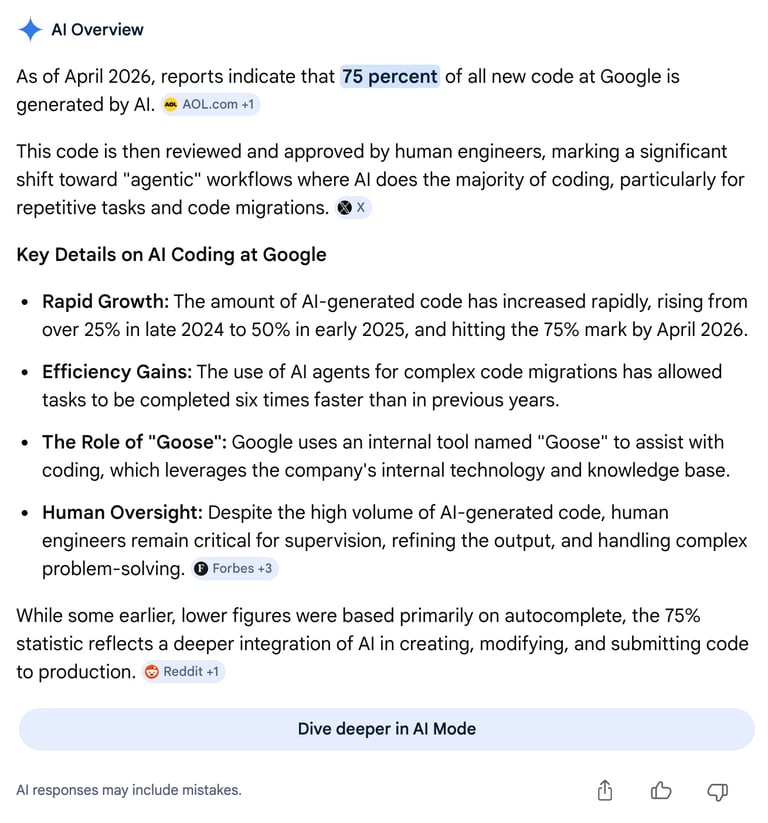
The integration of AI into development environments is reshaping how software is built on a daily basis. Workflows that once followed a linear progression from design to implementation to testing are becoming iterative and fluid. Engineers increasingly begin with intent, expressed through prompts or high-level specifications, and then refine AI-generated outputs through cycles of evaluation and adjustment.
This approach compresses development timelines while increasing the importance of oversight. Errors can propagate more quickly when code is generated at scale, making critical thinking and validation essential. The role of the engineer shifts toward supervision, interpretation, and correction. Traditional tools such as integrated development environments remain relevant, but their dominance is being challenged by AI-first platforms that prioritize interaction over manual input.
The result is a workflow that is less about writing code and more about shaping it. Engineers guide systems, set constraints, and evaluate results. The process becomes conversational rather than procedural, with intelligence distributed across human and machine actors.
Implications for System Design and Architecture
As implementation becomes increasingly automated, system design emerges as the central discipline of software engineering. The ability to define architecture, manage complexity, and ensure coherence across components becomes the primary determinant of success. Poor design decisions are no longer isolated issues. They can be replicated instantly through AI-generated code, amplifying their impact.
This places a premium on clarity. Engineers must articulate system boundaries, data flows, and performance expectations with precision. They must anticipate how AI-generated components will interact and ensure that these interactions produce stable and predictable outcomes. The margin for error narrows as speed increases. What was once a gradual accumulation of technical debt can now occur almost instantly.
In this environment, design is not a preliminary step. It is the core activity. Implementation follows automatically, but only to the extent that design is sound.
Industry Perspectives
Leaders across the technology sector have begun to articulate the implications of this shift. Max Levchin has observed that advances in AI are raising the baseline quality of software, making it increasingly difficult for poorly designed products to compete. This observation reflects a broader trend in which automation eliminates mediocrity by default. When high-quality output can be generated quickly, the tolerance for low-quality systems declines.
Within startup ecosystems, similar patterns are emerging. Leaders associated with organizations such as Y Combinator have noted that companies capable of integrating AI into their core workflows are iterating faster and outperforming peers that rely on traditional development models. The advantage is not limited to speed. It extends to adaptability, as AI-enabled teams can explore a wider range of solutions in less time.
These perspectives converge on a single conclusion. The competitive landscape is shifting, and the ability to adapt to AI-driven development is becoming a prerequisite for success.
The Redefinition of Engineering Value
As the structure of software engineering evolves, so too does the way value is measured. Traditional metrics such as lines of code written or familiarity with specific programming languages are losing relevance. They fail to capture the skills that now matter most. Value is increasingly tied to the ability to define problems, design systems, and leverage tools effectively.
This redefinition has implications for both individuals and organizations. Engineers must broaden their skill sets, developing expertise in system design, product thinking, and human-AI collaboration. Organizations must adjust their hiring and evaluation processes, prioritizing judgment and adaptability over narrow technical proficiency. The shift is not merely technical. It is cultural.
Strategic Implications for Engineers and Founders
For engineers, the path forward requires a deliberate shift in focus. Technical depth remains important, but it must be complemented by an ability to operate at higher levels of abstraction. Learning to collaborate with AI systems is no longer optional. It is a core competency. Engineers must engage with real-world problems, build systems that matter, and develop an intuitive understanding of how technology interacts with human needs.
For founders and technology leaders, the implications are equally significant. Teams must be structured around adaptability and speed. AI should be integrated as a foundational layer rather than an auxiliary tool. Product development cycles must be designed to accommodate rapid iteration, with systems that can evolve alongside advancing capabilities.
The organizations that succeed will not be those that resist change, but those that internalize it. They will treat AI not as a feature, but as infrastructure.
Conclusion
Software engineering is being redefined at its core. The transition from syntax to context represents a shift in both practice and identity. Engineers are no longer primarily builders of code. They are designers of systems, interpreters of intent, and orchestrators of intelligent tools.
This shift is already underway. It is visible in the tools being adopted, the workflows being reshaped, and the expectations being set by leading organizations. The remaining question is not whether the transition will occur, but how quickly individuals and institutions will respond to it.
Adaptation is no longer a strategic advantage. It is a condition for survival.